We are swiftly moving to a world where businesses will see AI agents as a primary channel for business processes. Chains of agents will push through a process from begin to end, monitor the process, chase up when processes fail and deal with exceptions.
The up-side is fantastic, business processes that are fast, efficient and with high levels of positive outcome. But when we look in detail at how LLMs achieve their goals a few warning signs start to appear. While an LLM’s creativity sounds fantastic when something in the business process goes wrong, it’s not always the case that the LLM will do what you expect, and often it will do what you don’t want it to do – and sticking to business rules is one of those areas where an LLM might take an approach which, while on the surface completes the process, could also cause major downstream issues.
This is made worse when you consider one of the emerging AI patterns which is goal-oriented or outcome oriented. A high level goal of completing the business process can lead to a LLM deliberately ignoring business rules because it is the business rule that is preventing the “positive” outcome. We can try to limit the agent or put guard rails in place, but we know that agents are not easy to contain, and this is especially when we are working with complex business rules.
Of course, in most cases today, the business rule is encapsulated in the application layer, and we have already seen cases where LLMs attempt to avoid the application and complete the business another way, perhaps getting access to the underlying database.
So this is where we need something new – how can we constrain agents so that they can’t get around business process rules?
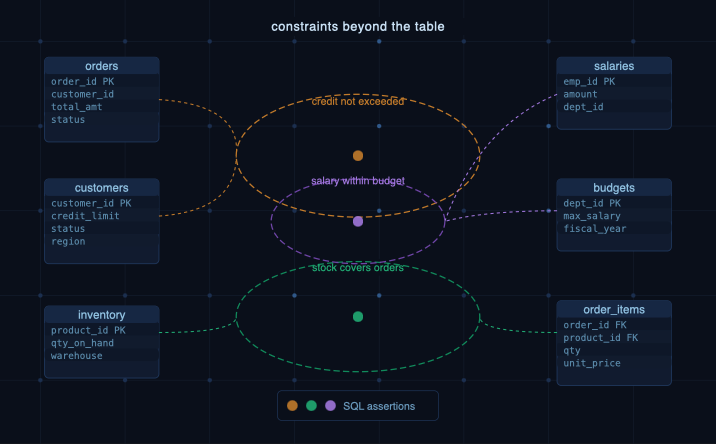
One obvious option is to build the rule into the database where there is no possibility of working around the rule – and the concept of database-wide SQL “assertions” have been around for some time – since SQL-92 , but never implemented – at least not until now.
Oracle AI Database 26ai is the first database to implement database level assertions, and while this may have languished as a minor feature, in tomorrow’s agentic AI driven businesses, perhaps this seemingly esoteric SQL feature is actually the only way we can protect our data and business processes in this new world.
 Simon Griffiths
Leave a comment