The Borrowed Projector
My father already knew his trade in his hands. Becoming a lecturer meant serving a second apprenticeship on top of it — and what he taught me in a darkened living room was never really about roof trusses.
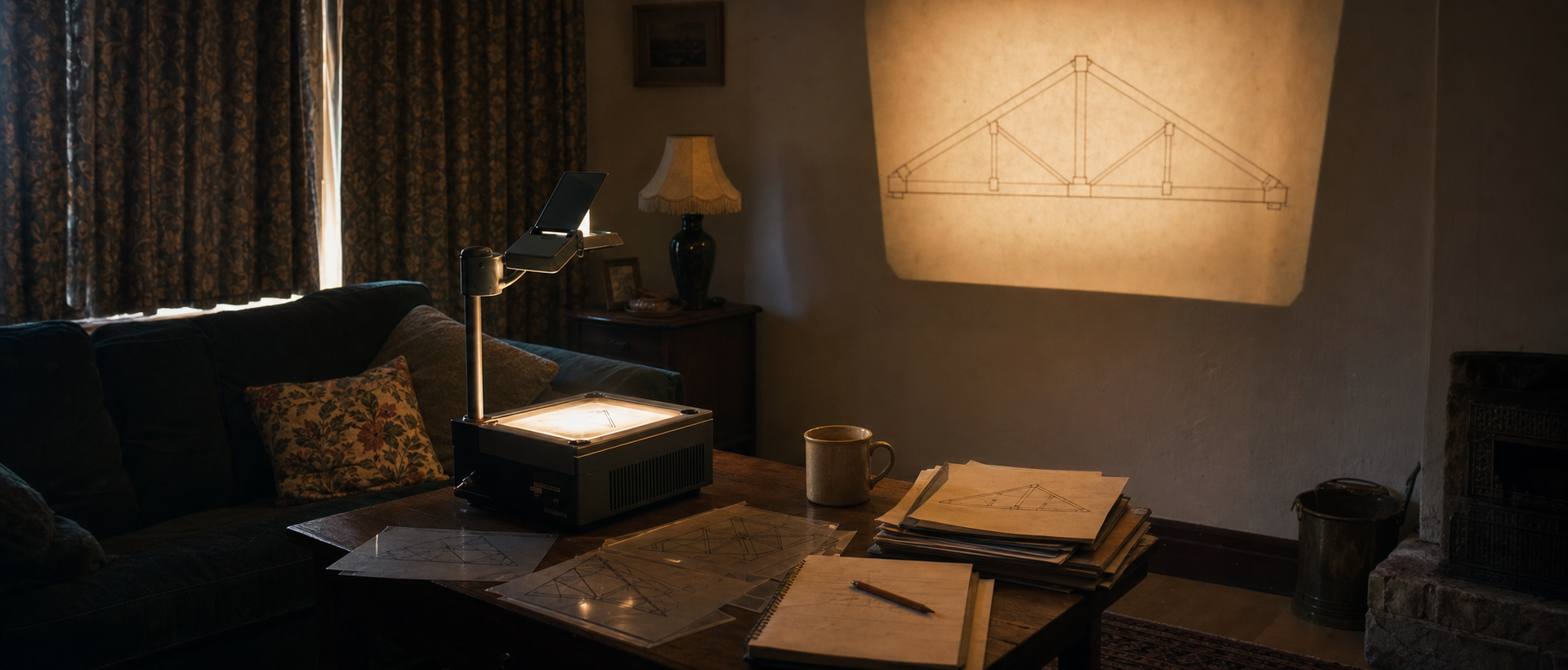
This is the fifth and final post in Craft & Code, a short Friday series about what carpentry can teach us about AI, skill and the future of software. Over the series I have used my father’s trade to think about what AI does to software work — to value, to training, to the gap between what looks finished and what is sound. This last one is the most personal, because it is about the thing I think we are most at risk of losing. It begins in a darkened living room when I was fourteen.
My father was training to be a lecturer. His hand had given out — the arthritis I mentioned in the first post — and teaching was the way his trade was going to carry him the rest of the distance to retirement. Part of qualifying meant delivering lectures, and one of the first he had to give was on roof trusses: king posts, queen posts, and the rest of the family of timber frames that hold a roof up, taught to the standards laid down by TRADA, the Timber Research and Development Association.
So our living room became a lecture theatre. He borrowed an overhead projector from somewhere, drew his diagrams onto acetate, closed the curtains against the afternoon light, and practised on the only audience he had: me. I sat through those rehearsals more than once. He would work through the whole thing, and then ask me what had been clear and what had not, where he had lost me, where it had dragged. And then he would do it again, better.
What strikes me now is that he did not need to learn the trusses. He knew them in his hands. He had built roofs; he had cut and fitted the real things in the real weather. The material was not the problem. The problem was the entirely separate craft of explaining it to someone who had never held a chisel — of sequencing it, pacing it, knowing which idea had to land before the next one would make sense.
That is the part of the lecturer story I most want to get right, because it complicates the comfortable version of everything I have argued in this series.
Across these posts I have leaned on the idea that craft “moves up the stack” — that when tools take over the doing, the human value shifts into judgement, design, review, diagnosis, teaching. I believe that. But watching my father in that darkened room taught me something the tidy version leaves out. Moving up the stack is not a promotion you are handed for being good with your hands. It is a second apprenticeship, served on top of the first.
He was an expert tradesman and a beginner teacher at the same time, in the same evening. The expertise was necessary and nowhere near sufficient. He had to graft at the new craft exactly the way he had once grafted at the old one — by doing it badly, getting feedback, and doing it again. The only difference was that this time his audience was a fourteen-year-old with an opinion, rather than a length of timber that told him plainly when he had got it wrong.
And here is why the first apprenticeship mattered so much to the second. Once he found his feet as a lecturer, what made him good was not that he had memorised the syllabus. It was that he had done the work. He could explain why a joint failed because he had had one fail on him. He could see a bad habit forming in a student before the student could, because it had once been his own bad habit. The authority came up out of his hands and settled into his voice. A lecturer who had only ever read about roofs could teach the facts. My father could teach the judgement, because he had paid for it the slow way, on real jobs, over real years.
That is the kind of teacher who cannot be conjured into existence. You cannot prompt it. You cannot shortcut the foundational years and arrive at the top of the stack with the judgement already installed. The judgement is made of the years.
There is a coda to the story that I have come to think is the most important part.
About a year into his new job, my father hit a wall. Some calculation he needed for his teaching turned on logarithms, and logarithms had not been part of his world. The master tradesman, the man who could read a roof at a glance, was suddenly the one who was stuck. And I had just been taught logarithms at school, a few weeks earlier, with the ink barely dry.
So at the same table where he had taught me trusses, I taught my father logarithms.
I have thought about that exchange for most of my life. When he sat me down in front of the projector and asked a fourteen-year-old what worked and what didn’t, and then actually changed his lecture based on what I said, he was not trying to build my confidence. His aim was to get the lecture right. But the by-product of being taken that seriously, that young, was that something in me grew that has never gone away. The logarithms, a year later, were how I paid it back, though neither of us would ever have called it that.
That is what formation actually looks like. Not a transfer of facts from the one who has them to the one who doesn’t, but a long, patient, two-way human exchange in which the teacher is sometimes the student, respect runs in both directions, and the most valuable thing being handed over is rarely the thing on the acetate. And it does not end with childhood. The longer I have worked, the more certain I have become that the expert learns at least as much from the student as the other way round. I certainly do — I learn constantly from the people I am supposed to be teaching.
I see the same shape in my own working life, which is perhaps why the memory has stayed with me so stubbornly.
I spent the first half of my career on the customer side, at the sharp end — building large, complicated systems inside organisations like BT and Vodafone, where the gap between the clean architecture diagram and the Tuesday-morning reality is where you actually live. I now work on the other side of the table, for a vendor, helping to shape the products rather than wrestle with them. And the thing that makes me useful in that role is not that I have learned to think like a product person. It is that I spent years in the mess: I know, from the inside, what it is actually like to run complex IT in a real business, with real constraints, real politics, and real consequences when something breaks at the worst possible moment. Like my father, I moved up the stack. But everything that makes the higher position worth anything was earned at the lower one.
I have spent four posts being fairly hard-headed about AI: who captures the value it creates, who stops getting trained, what it lets us ship that looks finished and is not. I stand by all of it. But the series ends here, on purpose, with a darkened room and a borrowed projector, because this is the thing underneath all the rest.
The facts are the part AI has in abundance. It can explain roof trusses, and logarithms, and almost anything else, instantly and tirelessly and at any hour. What it does not have, and what was never really in the tool, is the apparatus of forming a person: the presence, the patience, the iteration, the respect of taking someone’s half-formed feedback seriously, the mutual exchange in which both people are changed. A confident machine that hands you the answer removes the friction. But the friction was where the forming happened.
So I finish more or less where my father’s working life finished: believing that craft does not die when the tools grow strong. It moves — into judgement, into diagnosis, into teaching, into the slow human work of making the next person. That is real hope, and I mean it. But it comes with the condition this whole series has circled. Craft survives only if we still know how to form the people who carry it — and that is harder, not easier, in an age when the tools are powerful enough to hide the apprenticeship behind a finished-looking surface.
My father learned to teach in a darkened living room, with a borrowed projector and an audience of one. A year later, that audience taught him logarithms. I do not know a better picture of what we have to protect.
That brings Craft & Code to a close. Thank you for reading it. I will keep using Friday Coffee for this kind of more contemplative, non-technical thinking about technology, work and change.